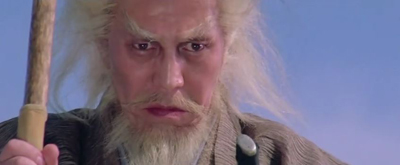
aka Shogun Assassin 4: Five Fistfuls of Gold. Sword of Vengeance. Kozure Ôkami: Meifumadô.
"I have come for your life."
Five warriors are trying to track down and challenge Ogami Itto (Tomisaburô Wakayama) to duels. Each holds a part of information and money needed to complete the assassination of a mad Daimyo as he plots to decieve his clan and the Shogun!
Number five in the Lone Wolf and Cub series sees a film with new depth and a renewed visual style, as Itto's story intertwines with that of a female pickpocket.
Showing posts with label Jidaigeki. Show all posts
22.1.23
15.10.22
Baby Cart in Peril (1972)
AKA Lone Wolf and Cub: Baby Cart in Peril. Kozure Ōkami: Oya no kokoro ko no kokoro.
"Those eyes."
Ogami Ittō, the disgraced former shōgun's executioner is hired to kill Oyuki, a tattooed female assassin, but whilst traking her down, Ittō's 3-year-old son, Daigoro goes missing.
The forth episode in the Lone Wolf and Cub series, mixes up a number of story lines including Daigoro showing his independence and resourcefulness.
"Those eyes."
Ogami Ittō, the disgraced former shōgun's executioner is hired to kill Oyuki, a tattooed female assassin, but whilst traking her down, Ittō's 3-year-old son, Daigoro goes missing.
The forth episode in the Lone Wolf and Cub series, mixes up a number of story lines including Daigoro showing his independence and resourcefulness.
Labels:
Buichi Saitō,
chambara,
Japanese,
Jidaigeki,
Samurai
sword of vengeance (1972)
AKA Lone Wolf and Cub: Sword of Vengeance. Kozure Ōkami: Kowokashi udekashi tsukamatsuru.
"I will make sure the shōgun settles this matter."
Set in Japan during an unspecified year of the Edo period, Tomisaburo Wakayama (Ogami Ittō), is a disgraced former Kogi Kaishakunin (executioner) to the shōgun, wandering the countryside, with his 3-year-old son Daigoro inside a baby cart.
The start of the Lone Wolf and Cub series, starts Itto's bloodbath journey across the countryside and delves into why he is an assassin with child.
"I will make sure the shōgun settles this matter."
Set in Japan during an unspecified year of the Edo period, Tomisaburo Wakayama (Ogami Ittō), is a disgraced former Kogi Kaishakunin (executioner) to the shōgun, wandering the countryside, with his 3-year-old son Daigoro inside a baby cart.
The start of the Lone Wolf and Cub series, starts Itto's bloodbath journey across the countryside and delves into why he is an assassin with child.
Labels:
chambara,
Japanese,
Jidaigeki,
Kenji Misumi,
Samurai
14.9.13
the tale of zatoichi (1962)
"...to be a gangster is a foolish way to live."
Blind masseur Ichi (Shintarô Katsu), has transformed himself from put upon masseur into master swordsman Zatoichi, with a weakness for gambling. This weakness leads him into a town divided between two gang bosses, one of which has a samurai on board...
A fine introduction to the world of the blind swordsman, and the trouble that inevitably follows him.
Labels:
Daiei,
Japanese,
Jidaigeki,
Kenji Misumi,
Martial arts
zatoichi and the doomed man (1965)
"Every time someone asks me a favour like this I get into trouble."
A condemned man begs Zatoichi (Shintarô Katsu) to find the two men who can vouch for his innocence. As usual, in helping out, Ichi ends up finding nothing but trouble. He also has to contend with a foolish character (Kanbi Fujiyama) pretending to be him, taking money from people who think he is Ichi, then running away when trouble starts, ruining Zatoichi's good name.
Solid entry in the series, with comedy, pathos and swordplay.
Labels:
chambara,
Daiei,
Japanese,
Jidaigeki,
Kazuo Mori,
Martial arts
zatoichi challenged (1967)
"Prepare to die Ichi."
A woman's dying wish is for Zatoichi (Shintarô Katsu), the blind ronin, to take her son to his father, an artist (Takao Ito) in another prefecture. But when he arrives, Zatoichi finds that the artist is being held by the Yakuza, and forced to make illegal pornographic artwork. Complicating matters is Tajuro Akazuka (Jûshirô Konoe), supposedly a master-less ronin, who may possibly be a government agent also on the hunt for the perpetrators of this forbidden art.
Considered to be one of the best of the series, this forgoes much of the fighting, to enhance the plot and character interaction.
Labels:
chambara,
Daiei,
Japanese,
Jidaigeki,
Kenji Misumi,
Martial arts
11.9.10
zatoichi meets yojimbo (1970)

aka Zatôichi to Yôjinbô.
"We don't see too many good amma around here."
Tired of killing, Ichi (Shintarô Katsu) heads to a village he remembers for its tranquility, to recoop. Unfortunately since his last visit it has been overrun with gangsters overseen by Boss Masagoro (Masakane Yonekura) and his enforcer Yojimbo (Toshiro Mifune). A father/son feud, and a rumoured stash of stolen gold hidden somewhere in the village complicate matters further and make sure that Ichi far from having a peaceful time, stumbles instead into trouble...
The series sees the arrival of another famous character to reinvigorate the storyline. What we get is a good if not great installment.
Labels:
chambara,
Japanese,
Jidaigeki,
Martial arts,
Yamato Satsuo
7.8.10
baby cart to hades (1972)
AKA Lone Wolf and Cub: Baby Cart to Hades. Kozure Ôkami: Shinikazeni mukau ubaguruma. Lightning Swords of Death.
"We all walk different paths in life..."
Ogami Itto (Tomisaburo Wakayama) meets Kanbei (Go Kato), a Ronin with principles, on the road. Kanbei asks for a duel. Itto walks away telling him it is was a draw, as he wants Kanbei to live, but this only serves to fester with the Ronin. Meanwhile Itto comes to help a woman sold into prostitution, who has killed her pimp, volunteering to be tortured by her owners to save her. As part of the debt Itto is then hired to kill an evil chamberlain...
The third in the Lone Wolf and Cub series, continues Itto's bloodbath journey across the countryside and delves deeper into the back story of the characters involved.
baby cart at the river styx (1972)
AKA Lone Wolf and Cub: Baby Cart at the River Styx. Kozure Ôkami: Sanzu no kawa no ubaguruma.
"No matter where you go there is no way you can escape from us."
Ogami Itto (Tomisaburo Wakayama) and his son Daigoro (Akihiro Tomikawa) continue their journey across Japan seeking justice, and trying to remain one step ahead of the evil Yagyu clan. This time the clan send a gang of female ninja to eliminate them and Itto battles the three Hidari brothers, otherwise known as the Masters of Death.
Part two of the series, (some of which made it into Shogun Assassin), sees yet more brain splitting action from the very start. A stunning sequel to Swords of Vengeance, shot through with Itto's perpetual unease and subsequent weariness at having to be perminently on his guard. And with Daigoro coming into his own, revealing his personality and resourcefulness whilst helping his father.
Labels:
chambara,
Japanese,
Jidaigeki,
Kenji Misumi,
Samurai
6.8.10
sword of vengeance (1972)
AKA Kozure ôkami: Ko wo kashi ude kashi tsukamatsuru. Lone Wolf and Cub: Sword Of Vengeance.
"Wash your neck and await my return."
Part one of the Lone Wolf and Cub series. Ogami Itto (Tomisaburo Wakayama) is the shogunates second, or executioner, who is framed for treason by a rival clan, wanting to exert influence on the Shogun. When his wife is murdered, he has to go on the run with his child, becoming a Ronin, a masterless samurai for hire. Meanwhile he has to remain undercover being sought out by the Yagyu clan who set him up.
Re-edited into 'Shogun Assassin', this the original is far superior and gorier, with an added drama and depth.
Labels:
chambara,
Japanese,
Jidaigeki,
Kenji Misumi,
Samurai
10.7.10
zatoichi meets the one armed swordsman (1971)
AKA Shin zatô Ichi: Yabure! Tôjin-ken.
"We're both human beings, but we still can't communicate."
Wang Kong (Yu Wang), the One-Armed Swordsman arrives in Japan and witnesses an attack on a family by some samurai. He kills some whilst trying to protect the child, who runs off, only to be found by Ichi (Shintarô Katsu). Ichi tries to look after the child, eventually meeting up with Wang, who has been blamed for the atrocity. Unfortunately misunderstandings develop between the two which can only lead to one thing, a duel to the death.
A Japanese hero meets a Chinese one and sparks fly. Another great chapter in the life of Zatoichi.
Labels:
chambara,
Japanese,
Jidaigeki,
Kimiyoshi Yasuda,
Martial arts,
Shintarô Katsu
6.7.10
zatoichi in desperation (1972)
AKA Shin Zatôichi monogatari: Oreta tsue.
"Without a stick, you can't cross the river to hell."
Ichi (Shintarô Katsu) meets an old woman on her way to Chosi to see her daughter (Kiwako Taichi), when he inadvertently causes her death. He decides to complete her journey and tell the daughter about the accident. Thus he gets involved in her life, finding her trapped in a Geisha house working off a debt, and comes up against local boss Mangoro (Asao Koike).
Number twenty-four in the series, sees no let up in the action, but also shows a darker and deeper sense of humanity, hurt and injustice. Ichi finds himself crippled and unable to hold a sword, knowing he has to confront his foes.
Labels:
chambara,
Japanese,
Jidaigeki,
Martial arts,
Shintarô Katsu
3.7.10
zatoichi at the fire festival (1970)
AKA Zatoichi Goes to the Fire Festival. Zatôichi abare-himatsuri. Zatoichi, the Fire Festival
"Gentlemen, looks as though its now that the real fun begins."
Zatoichi (Shintarô Katsu) stumbles into a village and runs fowl of the local gang boss, the Dark Lord Yamikubo (Masayuki Mori) and his protege.
Number twenty-one in the series sees an entry with plenty of action and comedy.
Labels:
chambara,
Japanese,
Jidaigeki,
Kenji Misumi,
Martial arts
zatoichi the outlaw (1967)
AKA Zatôichi rôyaburi. Zatoichi Breaks Jail.
"Surely you are not a statue, so why don't you play with us?"
Zatoichi (Shintarô Katsu) arrives at another village where two gambling house bosses are plotting each others demise. When ichi realises he has been taken in by one of the bosses, and everyone blames him for their wretched situation, he decides its time to rectify the situation and rescue a revolutionary ronin in the process.
The blind swordsman continues his journey in this his sixteenth outing. Entertaining but unevenly paced actioner.
Labels:
chambara,
Japanese,
Jidaigeki,
Martial arts,
Yamato Satsuo
27.6.10
assassination (1964)
AKA Ansatsu.
"What kind of man swings so easily from Emperor to Shogun?"
Its 1853 and the arrival of American ships breaking Japans traditional isolation throwns Japan into political turmoil. Hachiro Kiyokawa (Tetsurô Tanba) is an ambitious ronin who tries to use this tumult to further his own ends and shifts between political factions attempting to prevent the outbreak of civil war.
A strongly nihilistic film, exploring the concepts of honour, betrayal and how the previously honourable samurai have decended into political assassins.
Labels:
chambara,
Drama,
Japanese,
Jidaigeki,
Masahiro Shinoda
9.7.09
lady snowblood: love song of vengeance (1974)
Lady Snowblood (Meiko Kaji) having been caught, is sentenced to death for her crimes, but before she reaches the gallows she is rescued by the secret police who recruit her to infiltrate an anarchist group and retrieve an incriminating letter.
The follow-up to Lady Snowblood: Blizzard Of The Netherworld continues Yuki's story. Time has moved on and now she is in the midst of the political turmoil of Japan following the Russo-Japanese war. As politics rather than pure vengeance drives the story, it can at times get a bit convoluted, but saying that, Meiko still has presence and dominates the screen as she hacks her way through another truck load of unfortunate men.
Labels:
chambara,
Japanese,
Jidaigeki,
Martial arts,
Toho,
Toshiya Fujita
25.2.09
lady snowblood (1973)
Film based on the manga of the same name, about a woman born for one thing, revenge. This is the film that Quentin Tarantino based much of Kill Bill around, and even borrowed the theme song to make his homage complete. And who's to blame him as this is a stylish and stylized story.
Labels:
chambara,
Japanese,
Jidaigeki,
Martial arts,
Toho,
Toshiya Fujita
22.2.09
shogun assassin (1980)
Shogun Assassin was edited and compiled from the first two Lone Wolf and Cub films, for an American audience. This version is narrated by the child, Daigoro, and tells of how the Shogun tries to kill the titular Samurai, but only succeeds in killing his wife. Itto seeking revenge becomes a Ronin, a lone wolf, wandering Japan as a hired assassin with his child, chased by the Shogun's men.This results in almost wall to wall fighting, with over the top blood spraying from every concieveable body part. Some dislike this, prefering the original Lone Wolf films. Me I like them all. Lone Wolf is inevitably more complex and requres more time and effort, but Shogun Assassin is great for a quick fix. Added to this is the throbbing synth theme, that I love, and I'm not the only one: the Wu-Tang Clan obviously enjoyed it as well, as did Quentin Tarantino.
Labels:
chambara,
Japanese,
Jidaigeki,
Katsu Production,
Kenji Misumi,
Robert Houston,
Samurai,
Toho
Subscribe to:
Posts (Atom)